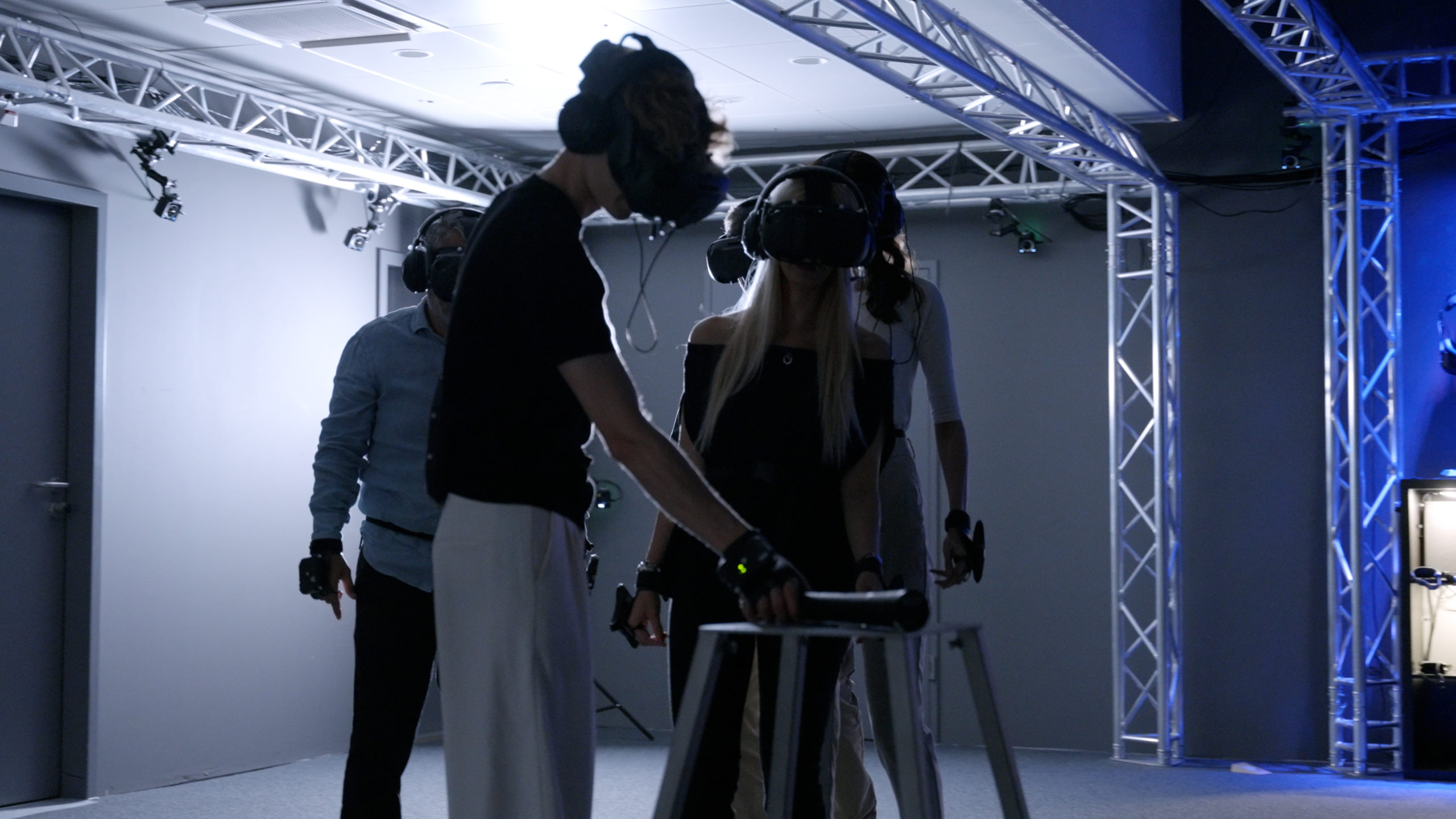
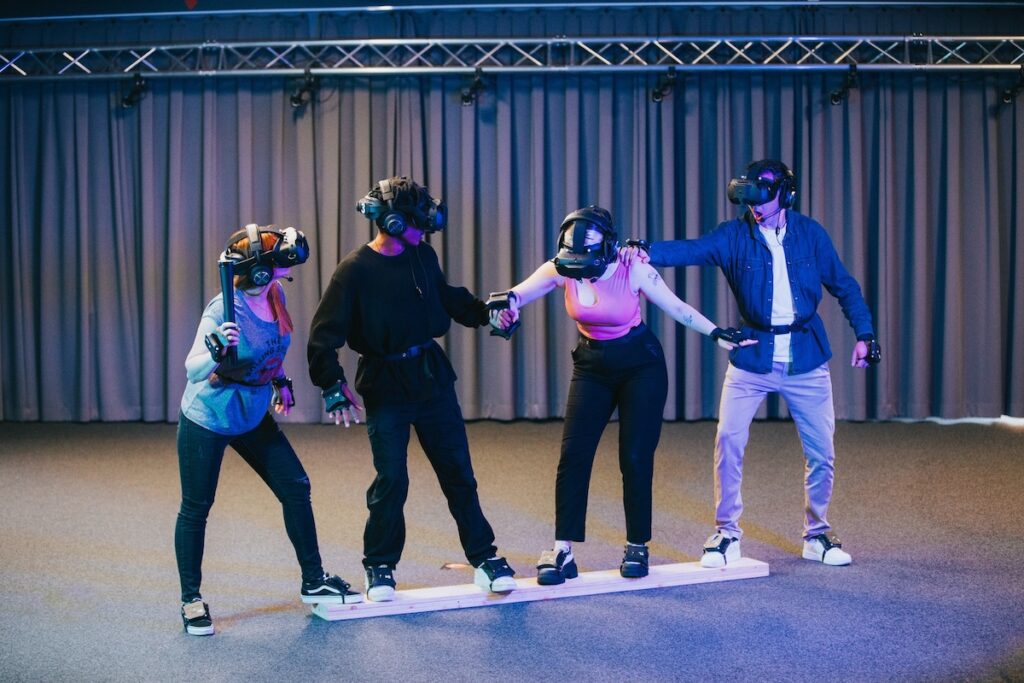
A narrow plank. A few centimeters above the ground. Completely harmless in real life. In the virtual world, there’s suddenly a chasm beneath it. That’s the moment it gets interesting: the brain reacts as if the situation were real.
The key is the concept of so-called presence. This refers to the feeling of actually being in the virtual environment. Research from Stanford’s Virtual Human Interaction Lab around Jeremy Bailenson shows that immersive VR environments are processed by the brain in a similar way to real situations when visual input, body movement, and spatial perception align.
When someone wearing a VR headset steps onto a plank and sees virtual depth below, the brain automatically activates risk assessment and protective mechanisms. Heart rate rises, the body tenses, and the gaze becomes more cautious. Even though you rationally know you’re in a room, the limbic system responds to the perceived height.
This principle is also used in science. Studies from the University of Oxford show that virtual reality can be used successfully to treat fear of heights, because the brain responds to virtual heights with real emotional reactions.
As soon as several people are in the experience at the same time, additional group-psychology effects come into play. People strongly orient themselves to others’ behavior. If five team members walk across the plank without hesitation, the social pressure on the sixth person automatically increases.
This is where nonverbal signals become crucial. Hesitating, stepping back, or a quick glance at the team are signs that someone feels unsure. At the same time, trust develops: team members encourage each other, give tips, or offer support.
That’s exactly what makes virtual reality team events so interesting. Research on using VR in training—including studies by the U.S. Army and the well-known PwC study on the effectiveness of VR learning environments—shows that immersion and emotional engagement can lead to greater attention, better retention, and more intensive collaboration.
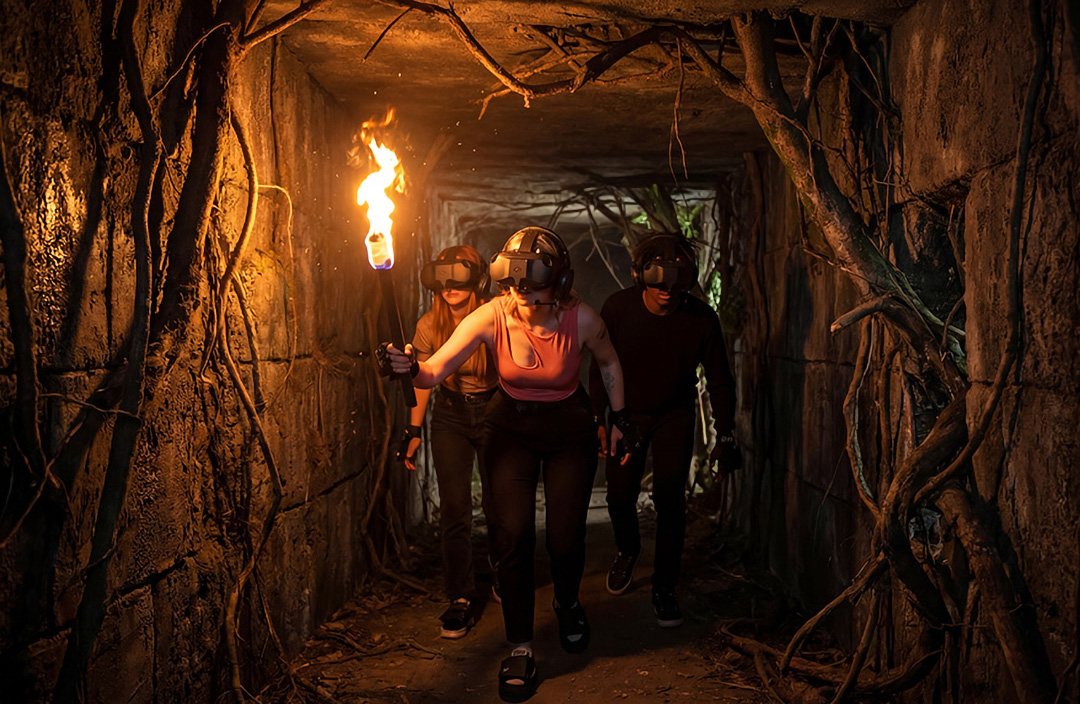
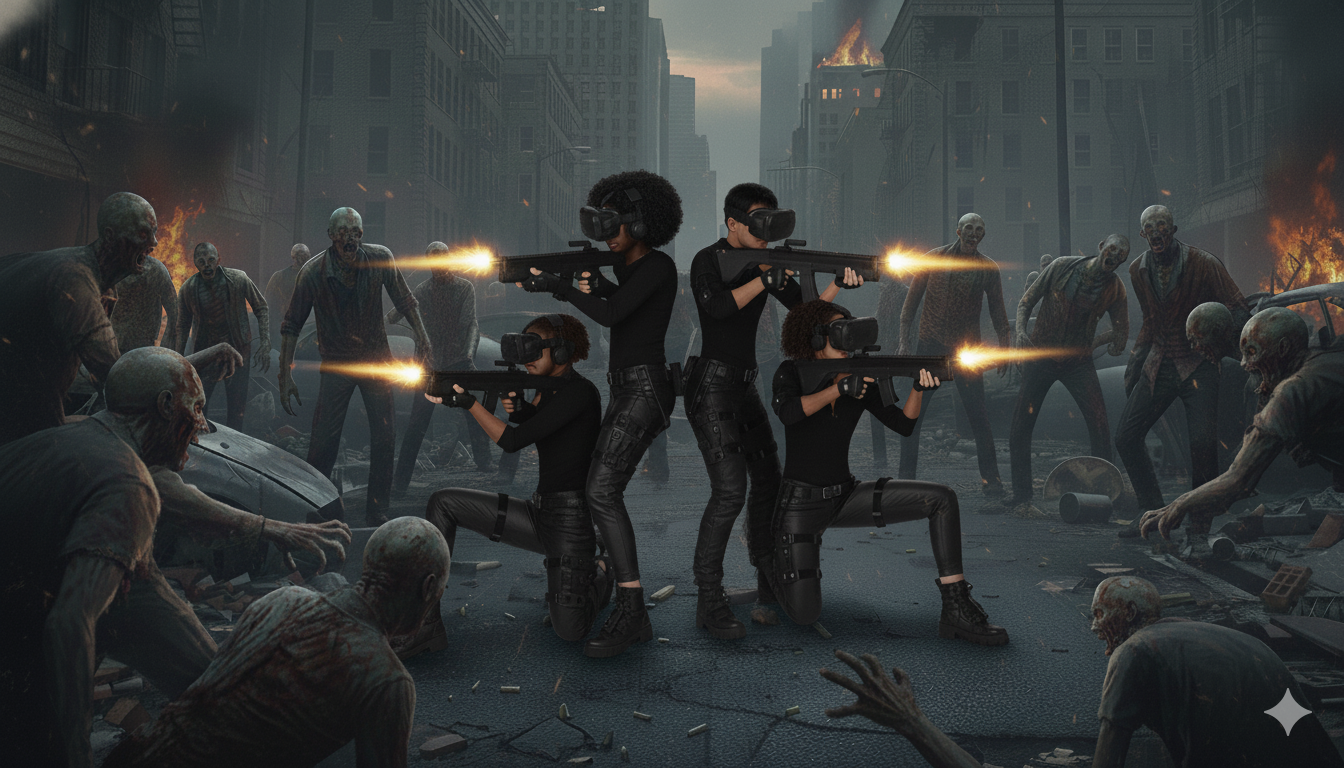
In a virtual reality center like the Fusion Arena in Switzerland, this dynamic is used deliberately. Teams move together through large VR worlds, solve tasks, and experience situations that naturally promote communication and collaboration.
In the end, the plank is physically only a few centimeters wide. But the situation triggers real emotions, real reactions, and real team dynamics.
That’s exactly why virtual reality team events are now one of the most exciting forms of team building and corporate events in Switzerland.
Have you ever experienced how a team behaves in a virtual environment?
Or even better: come by with your team and experience for yourselves what happens when collaboration suddenly feels real—even if the chasm is only virtual.
Sources
Image source: Pandally Fusion Arena
PwC (2020): The Effectiveness of Virtual Reality Soft Skills Training in the Enterprise
Bailenson, J. (Stanford Virtual Human Interaction Lab): Experience on Demand – What Virtual Reality Is, How It Works, and What It Can Do
Freeman, D. et al., University of Oxford (2018–2020): Studies on treating fear of heights with virtual reality
U.S. Army Research Institute: Studies on the effectiveness of virtual reality training
Slater, M. & Sanchez-Vives, M. (2016): Enhancing Our Lives with Immersive Virtual Reality